Classical Notes
Introduction
As a classical teacher, I work diligently to combat the effects the modern world has had on the human mind. Not only has modernity tricked us into thinking that we’re mere machines whose sole purpose is work, but we’ve been conditioned to believe that using the mind is something it’s not: utilitarian, inefficient, and unnatural. Some of the greatest thinkers throughout history understood the mind as the exact opposite of how we view it today, from ancients like Aristotle, to more recents like C.S. Lewis. They, and many others before us, knew that outsourcing the mind leads to its atrophy. Even Plato called for others to exercise caution when using something as simple as a writing utensil, alluding to the fact that it allowed too much power for the human to transcribe information to not be known, but archived—thus weakening our capacity to be thinkers. The atrophy of the human mind due to technology isn’t a new concept. But modern tech and AI risks something much more than what a pencil and paper ever risked, now made manifest by minds that believe they know what it means to think despite the continuation to ask AI for something they will forget weeks, days, and sometimes hours later. Classical Notes is my humble attempt to allow you, the repentant thinker, to begin reclaiming what was lost so long ago. It’s an answer that approaches the AI problem head on by prioritizing a return to thinking, learning, and education’s truest purpose: to form competent, free minds capable of realizing their intellectual lives rather than neglect or outsource them.
What Makes Classical Notes Different From Any Other Note-Taking Strategy?
Classical Notes are notes that teach you how to use your mind rather than outsource it, with the added benefit of you learning whatever it is you were studying. Today’s most popular note-taking methods focus on one thing: storage of information rather than cultivation of knowledge. Here’s my honest take on some of the most popular note-taking methods today:
Outline Method
Purpose: Quick hierarchical capture of information.
The Issue: Easily turns into passive transcription of information, word-for-word.
The Outcome: Information forgotten as quickly as it was written, requiring later review.
Cornell Notes
Purpose: Cues and notes for later review.
The Issue: Weak utilization of learning strategies that oftentimes mimics the same issues as the Outline Method.
The Outcome: The beginnings of knowledge formation, which quickly return to outsourced information after the note-taking occurs.
Obsidian/Zettelkasten
Purpose: Build a repository of information (second brain).
The Issue: Promotes an endless amount of information to be stored that, without effort on the part of the user, is knowledge unknown. Oftentimes requires more thought on how to make the system work for you, rather than inherently working for you at the start.
The Outcome: The accumulation of uncompleted, unthought-of work that is oftentimes left forgotten (backlog paralysis).
Popular Journaling Methods (Commonplace, Compendiums, etc.)
The Purpose: A tool to promote thinking about a subject.
The Issue: Best use of these methods require knowing how to think from the start, and discipline from the user so that information isn’t passively transcribed.
The Outcome: Information typically becomes transcribed rather than gained as knowledge, requiring significant thought on organization of the material to make it better suitable for learning/reviewing at a later date.
What Most Modern Note-Taking Methods Get Wrong
If you’ve ever taken notes before in an attempt to learn something, which then needed re-reading once, twice, and sometimes even more, you know exactly the issues outlined above. The problem is that most note-taking strategies, even done well, assume that the student will re-read them to learn the information, which is one of the greatest misconceptions of how learning best occurs. A good example of this can be seen in cooking or baking (both of which I thoroughly enjoy). How often do you make the same recipes, yet still need to reference the ingredients list and steps to prepare the meal/dessert?
Learning is not best achieved through continuously subjecting yourself to material (i.e. re-reading), but rather through purposeful study of the material in a process that allows you, the thinker, to construct the knowledge as you go. If you’ve ever completed a commonplace notebook, Obsidian file, or Notion dashboard but have found yourself constantly needing to reference information that you wish you knew (or working harder to understand the best use of the strategy than simply using it), you’ve experienced the core of the modern issue; creating repositories of information do little to help you know information, because the most important skill necessary—thinking—is something that is up to the learner, not the strategy.
But there’s a second issue: most modern note-taking systems, applications of learning strategies, and the people that promote them, prioritize learning as a means to enhance productivity, which creates sophisticated intellectual workers rather than free human beings capable of enjoying learning as both an act of work and leisure—another aspect that the ancients knew well. There’s nothing wrong with learning for productivity, but when we place it as learning’s ultimate end the activity becomes more of a chore than an innately human experience. The result? Less people participating in a fundamental human act—a direct result of the tech driven, total-work world that so many of us have begun to seek separation from. The fix? Taking on the act of thinking in the most human way by relearning what it means to think.
Classical Notes wont think for you, because thinking is done by the human mind. Instead, they walk you through the thinking process, teaching you the most important skill that many note-taking strategies neglect, modern education systems have avoided, and modern tech seeks to outsource: knowing how to think. They do so through the classical approach to learning and thinking that serves as the foundation for all that we know about the subject today: the Trivium—a three-stage process that exemplifies how knowledge is formed, regardless of subject matter. This is how the ancients learned how to use the mind so well, and it’s now yours to relearn for yourself, and all it takes is a single sheet of paper for each study session you want to complete. Although not an all-inclusive explanation, the three stages of the Trivium can be viewed as such:
Grammar Stage (Memorize): establish foundational information of a subject.
Dialectic/Logic Stage (Apply): use the foundational information established in the Grammar Stage to work though the deeper meaning of the subject (questions, argumentation, logical reasoning, etc.)
Rhetorical Stage (Summarize/Synthesize): Summarize the subject matter in your own words and apply it to your own life. Make the knowledge your own.
The Classical Notes Sheet
For years we’ve been aware that the tech promised to help us progress has allowed us to drown ourselves in information while simultaneously decline in knowledge and thinking. This is the only note-system that will help you change that reality and take back your mind. Here’s a quick look at the sheet.
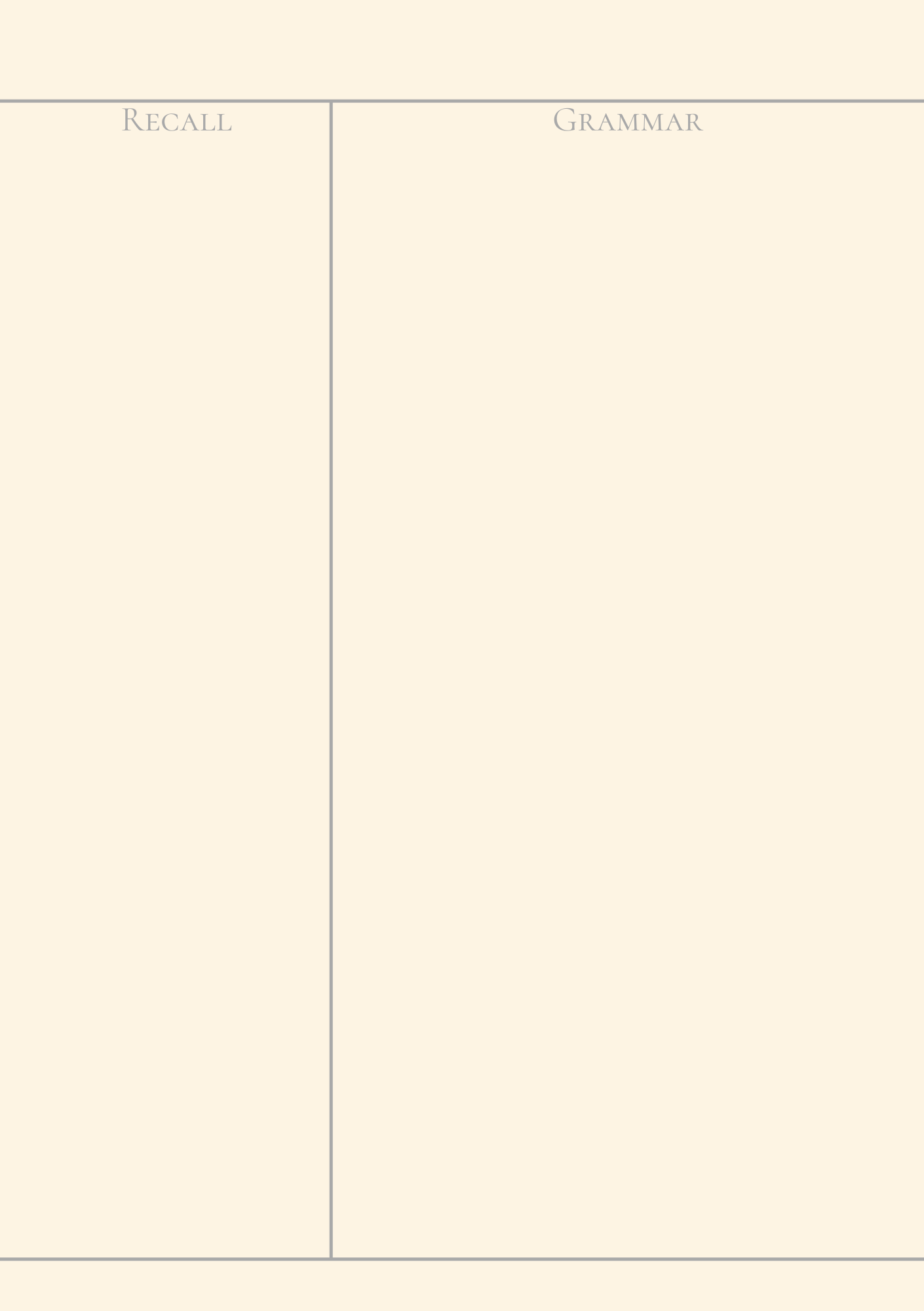
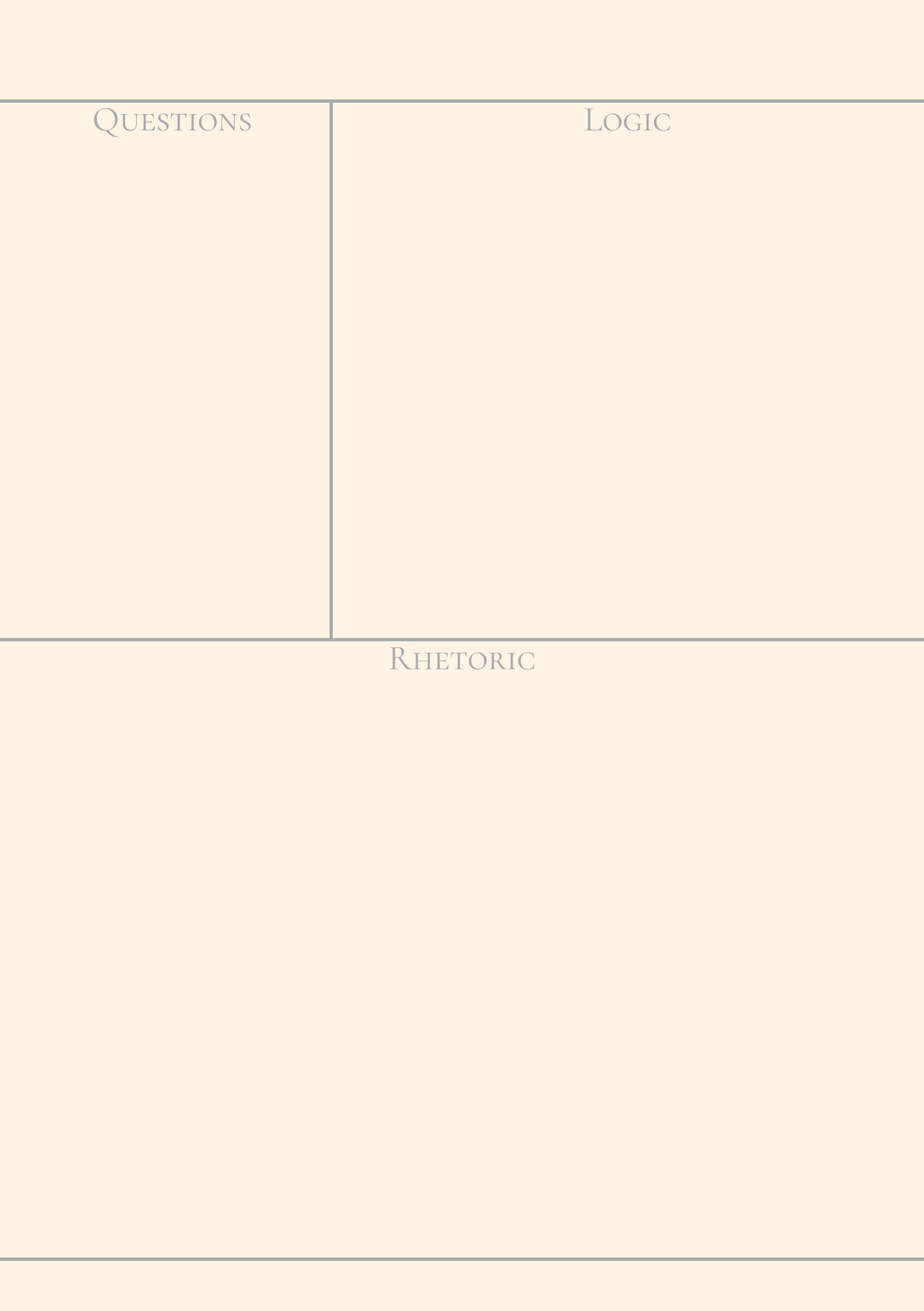
One double-sided sheet. One complete Trivium cycle. Real work that is scalable to any time constraint—whether it be a 20 minute study session or deep thought across multiple days— and any purpose—such as taking notes during a lecture or getting the most out of a past reading session. But how is it done?
The Classical Notes Process
The Classical Notes sheet is broken down into three sections, which are each devoted to one of the Triviums stages. At it’s simplest, each stage is intended to help you build knowledge as you learn the subject for the first time, starting with taking note of the fundamental parts of the content, then reasoning through the content to begin making connections and applying it to related—and sometimes unrelated—information, and finalizing the information into knowledge through the use of summarization and synthesizing of the material. Here’s a brief overview of each part of the Classical Notes process, including what each stage will accomplish and how you, the learner, can make it happen.
Grammar Stage
Note-Taking Phase 1: Recall
Time Range (Examples): 2-6 minutes
What It Accomplishes: Forces honest retrieval of information pertaining to your study (i.e. everything you remember from a previous session, book chapter, lecture, etc.)
How to Do It: Spend time writing all of the information that you remember, starting in the Recall column on Page 1.
Note-Taking Phase 2: Initial Notes
Time Range (Examples): 7-23 minutes
What It Accomplishes: Raw, faithful capture and active interrogation of the new material, including every confusion, wonder, contradiction, or doubt that pops into the learner’s mind.
How to Do It: After the Recall Phase, begin writing down all of the most important information regarding the subject and your understanding of it, taking mental notes of questions that arise during your initial interaction with the material.
Logic Stage
Note-Taking Phase 3: Reasoning and Questions
Time Range (Examples): 7-18 minutes
What It Accomplishes: Dialectic, discursive, productive struggle with the new material to begin making sense and memory.
How to Do It: After your notes have been taken, begin wrestling with the information by writing down any questions that are relevant to your understanding of the subject, and applying techniques that not only force you to recall the material (i.e. refraining from looking at the previous stage), but also rationalize it in a way that transforms it into deeper understanding.
Some examples of techniques to use during this stage:
Concept mapping
identification and paraphrasing of key arguments/ideas
Practice with the material
Rhetoric Stage
Note-Taking Phase 4: Summary and Synthesis of Knowledge
Time Range (Examples): 4-13 minutes
What It Accomplishes: Solidifies the newly studied material into memory that is the learner’s own.
How to Do It: Refraining from any of the source material or notes taken in the previous stages, apply techniques that help you convert your understanding of the material to more cohesive knowledge that sticks with you.
Some examples of techniques to use during this stage:
Summary of the content in your own words, ranging from a single sentence to multiple paragraphs.
Construction of analogies
Soliloquy (dialogue with yourself about the information)
*Optional Bridge Stage
To enhance your learning even further, you may “bridge” between Trivium Stages and/or Note-Taking Phases by taking a short break (30 seconds to 5 minutes), in which afterwards you refrain from looking at the sheet and “discuss” out-loud (whether by yourself or with a friend) the information you have learned so far (2-5 minutes).
An Example of What A Classical Notes Session Looks Like
Here’s a filled Classical Notes sheet from a study session I completed while I was reading Josef Pieper’s The Philosophic Act.
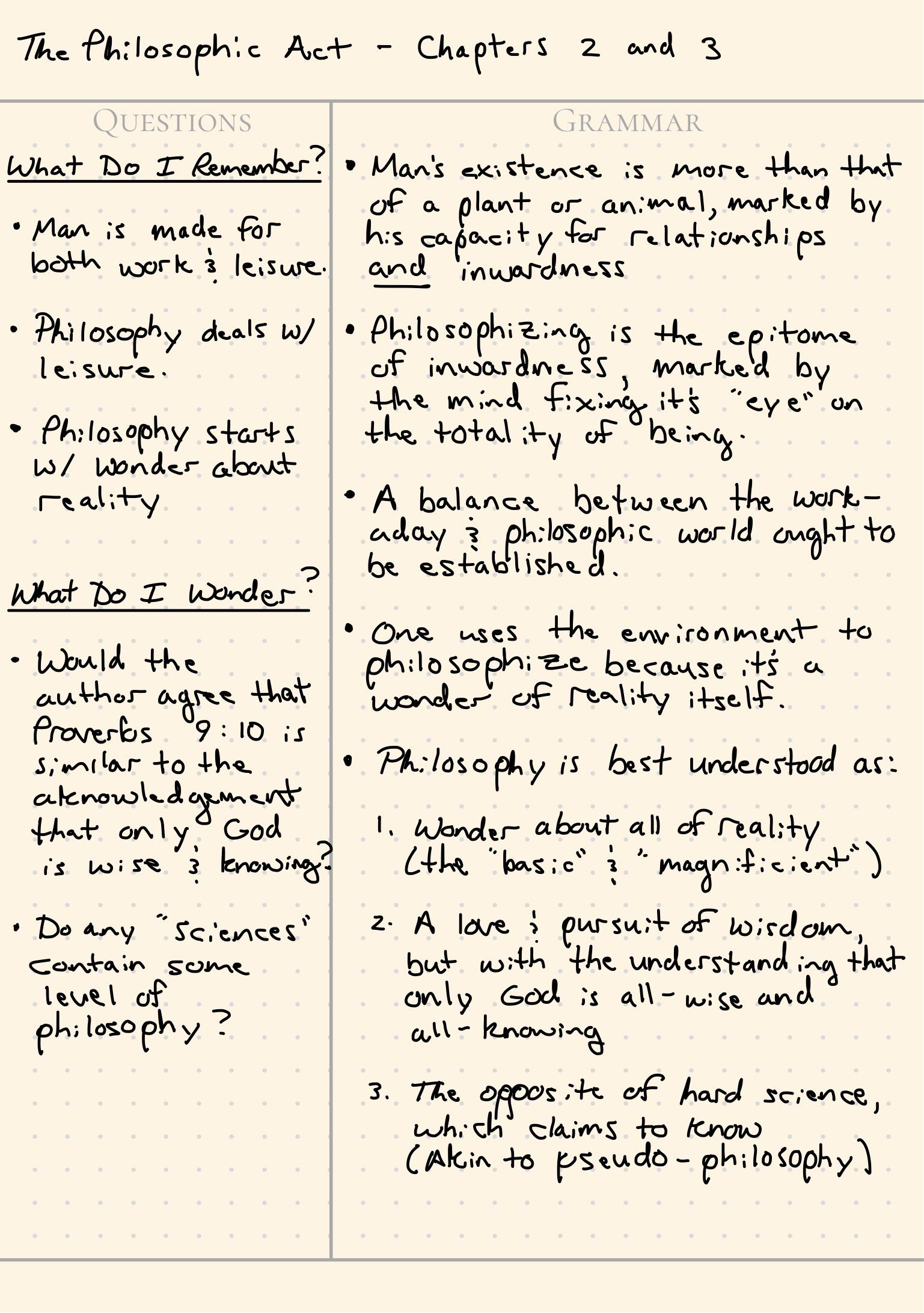
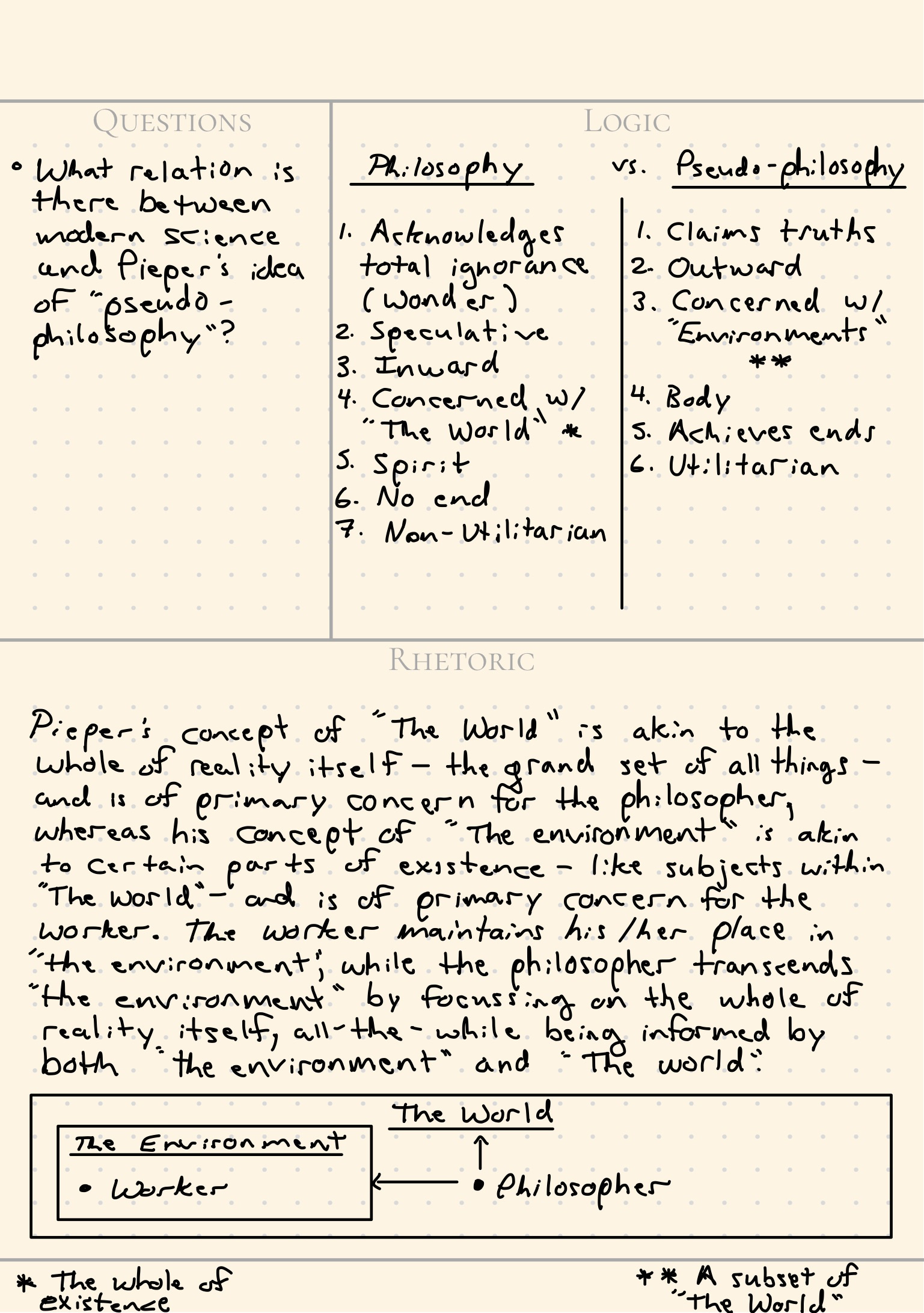
Using this example and the explanation of the Classical Notes process, you may begin to fill in the pieces of how you, too, can begin to form your own knowledge by taking useful notes. But, for your added benefit, here’s a quick-start guide to further help you through your first session or two:
Classical Notes Quick-Start Guide
Start on Page 1 (Recall and Grammar)
Recall previously learned, related information, starting at the top of the Questions column.
Read, listen to, or review the material that is being learned (book, podcast, lecture, etc.), filling the Notes column in real time or after; It could be minutes, hours, or even days (my favorite is to take notes on something I read the day—or morning—before).
Optional Bridge Stage.
When all of your notes have been taken, begin Page 2 (Questions, Logic, and Rhetoric)
Wrestle everything into useable form. Logic and reason your way through every piece of information and question that you can, adding to the list of questions as you go.
Optional Bridge Stage.
Finishing with the Rhetoric section, make the material your own by constructing some form of summary that requires you to recall the information contained on the entirety of the page.
Optional Bridge Stage.
What Classical Notes Does for the Learner
Forces the learner to follow the foundational, structured approach to learning—the Trivium—that all other methods have since tried to replicate.
Forces the learner to apply best learning practices (retrieval, interleaving, desirable difficulties, testing effect, segmentation, synthesis of information, etc.), as established by some of history’s greatest minds and verified by modern cognitive science.
Prioritizes the learning process as something that should be both difficult and meaningful.
Allows the learner to re-learn how to think by balancing discursive work and contemplative thought, thus resulting in ownership of information rather than outsourced information.
Next Steps
Now that you have the tool to take back your own mind, try it out for yourself. Find something you want to learn; Pick a book you’d like to read, or maybe even listen to an online lecture on a topic that interests you, and begin forging your mind anew. For those of you who have fallen prey to the tech-driven total-work world, let this be the start of your own mind’s renaissance. For those of you who have tried all of the other methods out there, yet still want to become better thinkers, let this be the beginning of your journey towards understanding what learning and thinking really is.
Thank you for your time, and happy learning!
If you haven’t already, download your FREE Classical Notes template to start today.