
Why Communities for Self-Learners Are So Important (And How I Intend to Provide My Own)
Personal Reflections on my Own Education, Thoughts on the Current State of the University, and an Introduction to The Classical Mind Book Club

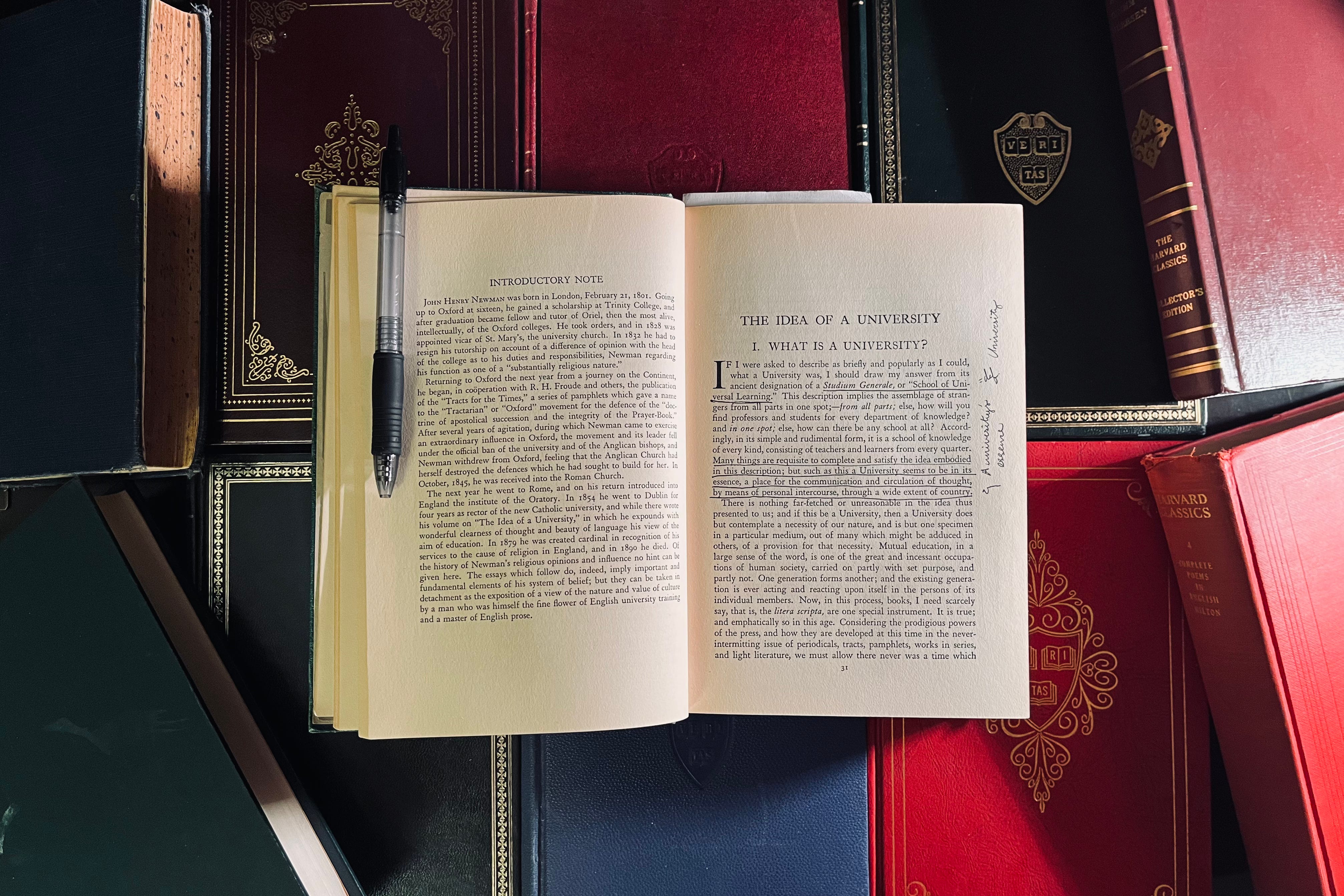
Many of us are enamored with ideas of things from the past that are far from what modernity actually offers. Art, music, and culture all come to mind, but one that has always stood out to me is the idea of the university. I remember feeling a sense of renewal as I stepped onto a college campus for the first time as a newly enrolled undergraduate student, thinking I had finally come to a place that would be free of the monotony and forced perception—a perception of learning as strictly a means to acquire a job—that my primary and secondary schooling established within me. How wrong I was. Instead it was the final step of my schooling: a requirement that took all of the pragmatic, efficient, and economic-first approaches to learning that defined my previous twelve years. Rather than freeing me from such mindsets, it amplified them, with the only benefit being that I ended up with a piece of paper that marked a readiness to work. This naivety followed me as I continued into graduate school, where I completed a masters degree and two years of PhD studies before I finally turned away because of the persistent ethos that was contrary to my thoughts on what a true education should provide for the student. The problem today is that there are an increasing amount of people who seek the same idea that I sought in a university—the idea that learning has much more value than preparation for a job—but have fewer and fewer places to find it. This is my first step towards at a fix.
The Result of Machine Learning in the Machine Age
What the university has become hasn’t been for nothing, and the new framework has become somewhat “essential”. After all, the Machine Age calls for certain types of systems so that it may keep moving forward. The education system of modernity does a magnificent job in doing exactly that, being more indicative of what C.S. Lewis labeled as “The New Education” in The Abolition of Man (which I discuss more of here). This business-like model of education is the heart and soul of the Machine because education, in many ways, determines the heart and soul of a culture. As the saying goes: Education is formation.
Because of this, education has been a subject that almost every serious thinker throughout history considered, from Francis Bacon, who wrote in his essay Of Custom and Education:
“Men’s thoughts are much according to their inclination; their discourse and speeches according to their learning and infused opinions; but their deeds are after as they have been accustomed…
…Therefore, since custom is the principal magistrate of man’s life, let men by all means endeavor to obtain good customs. Certainly custom is most perfect when it beginneth in young years: this we call education; which is, in effect, but an early custom.”
to the poet, John Milton, who in his opening lines of his Tractate on Education claimed that the subject was one of the highest to consider:
“I am long since persuaded, that to say, or do aught worth memory and imitation, no purpose or respect should sooner move us, than simply the love of God, and of mankind. Nevertheless to write now the reforming of education, though it be one of the greatest and noblest designs that can be thought on, and for the want whereof this nation perishes, I had not yet at this time been induced, but by your earnest entreaties, and serious conjurements…”
These two quotes frame the current issue of education quite well: Education is best achieved when it starts at a young age, and it’s oftentimes used as a tool to help a culture achieve it’s ends. Today’s education helps the Machine achieve its ends wonderfully, but the issue is this: instead of starting from scratch and establishing a system with new roots, the Machine took the original, older idea of education and sickened it from within without first considering how important it was and still would be.
After almost 20 years pursuing education, the thing that became most clear to me was that my idea of a university—an idea traced back to Plato’s Academy and the concept of leisurely pursuing knowledge as a means to discern goodness, truth, and beauty rather than to prepare individuals for white-collar trades—was no longer reality. It’s roots were dead, and although my experience was a result of attending universities that were far from the “best”, even the “best” have fallen prey to the modern perception of education that I’ve described; They’ve just held on longer because of how strong a branch of the original idea they were from the start.
The type of education I sought was one rooted in the liberal arts, expanded through the humanities, and one focused more on the cultivation of a whole human—body, mind, and soul—than the useful parts of him for the total work world he was a part of. I wanted classical, but the world gave me modern. I wanted philosophy, art, literature, and ideas, but the world gave me STEM, cognitive tasks, and skills. I wanted a comfortable, soul-filled room with books and deep conversation among passionate, inquiring minds, but the world gave me a sterile hall filled with fluorescent lights and attendees who simply clocked in and clocked out.
Sure, you can argue that someone like me could have had the power to find some light amidst the darkness (or to “make the best of it”, if you will), and in some ways I did. But I’m not much for making a heaven out of hell; and you can talk about reform, but when a tree is dead there’s not much that reformation can do. Sometimes the only thing that’s left is to create your own light by planting a new seed.
The Best Education is the One You Can Give Yourself
One of the best things I ever did, in light of the revelation that my “higher” education imparted on me, was to take learning into my own hands. Despite being a straight-A student and how far I went into the educational machine, I walked away feeling less like an intellectual and more like an intellectual worker; I was prepared for a job rather than a lifelong pursuit of learning and thinking deeply. So, with papers to show the world that I could earn a living, I chose to embrace the life of an autodidact.
Not only would I right the wrongs of my formal schooling by studying old books that most of my former teachers considered useless, but I would focus on cultivating a skill that was seemingly forgotten in my most critical years: how to think. But it was a rough go, and for anyone who has taken on the task of learning for themselves—be it through reading, writing, developing study plans, or seeking out others who are on a similar path—you’re probably well-aware of the struggles an autodidact faces.
Self-learning in the modern age—an age defined by declining literacy rates, constant information flow, tools marketed as “essential”, and fractured and declining education institutions that both students and teachers are turning away from—is something that has become quite common, despite the confusion and difficulty that comes with it. But because of this environment we self-learners find ourselves in, the problems that we face are many.
In most cases, our desire for learning and thinking is sparked by how little our world promotes them. Many of us feel that the foundational education we received could be called anything but a foundation, forcing us to seek out how to achieve basic intellectual skills—like reading, writing, and speaking—in our adult lives. Yet we also desire to acquaint ourselves with the rich works of our past—the classics—that much of our modern education either neglected because of their “irrelevancy” or chastised because of ideological differences. Then there’s the question of time: a fleeting and most valuable resource for autodidacts who are not only required to focus on their responsibilities as husbands, wives, fathers, or mothers, but also their responsibilities to their careers.
The result of these issues has been this: a vast amount of people who want an education rooted in it’s original purpose, but feel as if they are in need of so many pre-requisites—like intellectual abilities, valuable informational resources, guidance, and time—that what they really need is what the original university was, all-the-while modern educational institutions continue to erode that ideal, or place it behind an ever-increasing paywall that is unrealistic for every learner to pursue.
Despite these difficulties, many who wish to pursue their intellectual lives in the spirit of this ideal have begun to do so for themselves in a metaphorical desert, which is an environment that’s easy to go astray in when traveling alone. As such, there’s been sporadic efforts to provide some semblance of what so many self learners today seek, like learning skills, great books, and a welcoming community to bring like-minds together to help each another grow. But even these resources aren’t without their faults, with some of them only being made available to certain numbers during certain times of the year, others focusing on a limited scope of study, or more that seem too daunting for the learner who has never been a part of such a group before.
As someone who has found himself in this desert, taken on such a life, and came out the other side more fruitful than ever, I would be amiss if I were to not help others in similar circumstances. So what can I offer?
The Classical Mind Book Club
What I can currently offer is this: a book club. But what I’m advocating for—and what this book club will really be first steps towards—is a movement; it will be a resource to bring self-learners together and uplift one another during a time when learning, thinking, and community are more necessary than ever. But it will also be my contribution to revive what modern education has continued to uproot. It will be me, and whoever else would like to take part, planting the seed of education’s original idea so that it may carry on into the future. So how will it work, and how will it be different than most book clubs?
It’s Structure
The Classical Mind Book Club will pursue a study of texts in a way that promotes the cultivation of real, human thought, the learning about classical works, and community among those who wish to prioritize their intellectual lives in the spirit of the original university—an endeavor that is primarily concerned with the philosophical pursuit of wisdom to fulfill the whole self.
To describe this intellectual life and purpose of study, Hugh of St. Victor writes in his Didascalicon,
“But we are restored through instruction, so that we may recognize our nature and learn not to seek outside ourselves what we can find within.”
To understand this original structure of the university, one may look to John Henry Newman’s The Idea of a University:
“…but such as this a University seems to be in its essence, a place for the communication and circulation of thought, by means of personal intercourse, through a wide extent of country.”
To achieve all of this, The Classical Mind Book Club will provide the following:
Paid Subscriber Benefits
Daily discussion prompts via chat to prioritize continued reading, thinking, and active learning.
Weekly meetings to initiate dialogue among members.
Monthly essay prompts to act as an influence and guide for deeper thought and active learning.
Access to The Classical Mind Archive: a collection of resources for you to search—and contribute to—a variety of additions to help you with your personal study of the material, including:
Annotations
Notes
Mini Essays
Commentaries
Free Subscriber Benefits
Ability to read along with the texts.
Viewer-only access to the daily chat.
Delayed access to recorded videos of weekly meetings.
Our First Year of Study: The Harvard Classics
Our first year of study will commence with the book collection and study plan that started my own autodidact journey and my initiation into classical texts: The Harvard Classics—sometimes better known as “Dr. Eliot’s Five-Foot Shelf”—through Dr. Eliot’s 15-minute a day reading plan. This is something I’ve briefly discussed in a previous article, here, and I think it’s the perfect set of books and study plan to combat the issues I’ve mentioned:
Time: 15 minutes of reading per day is something that’s more realistic for learners with busy lives than the standard “chapter-per-day” that accompanies most other book clubs, establishing meaningful, consistent reading habits rather than the feeling of checking off a box.
Learning and Thinking Skills: 15 minutes of reading per day allows for additional time for annotating, note-taking, and more time thinking about what you read rather than consuming more information to simply be forgotten.
Cost: Because of their age, every text within the Harvard Classics collection can be found for FREE on the internet. But if you can’t gain access to the free pdf versions (or prefer the use of a Kindle), the entire collection can be purchased digitally through Amazon for roughly $2.00.
Experience with Classical Texts: In the teacher world, I call a study of texts like this a “low-floor, high-ceiling” activity, which simply means that it allows any learner, regardless of ability or familiarity with the texts, to get the most out of their studies. The Harvard Classics, per Dr. Eliot’s 15-minute a day reading plan, does this in a few ways:
Wide range of subject material: These books are perfect as an introduction for anyone new to the classics, but equally as meaningful for the dedicated learner who wishes to think more deeply about their connections.
Reading Interests: Dr. Eliot’s reading plan looks at some of the greatest parts of the Harvard Classics, rather than its entirety. Beginning learners can use this as a way to establish a solid foundation by jumping from text-to-text (each day of Dr. Eliot’s reading plan chooses a different text to read), whereas dedicated learners can go as far as they want in the daily texts if they choose to.
Old Books/New Thoughts: Although old, the Harvard Classics contain some of the most influential written works up to the 20th century. Not only do they give great insight into what was, but they also serve as a great way to observe the change that we’ve seen with creative works and ideas today; and for anyone who has read them before, they’re depth allows for multiple reads throughout a lifetime.
A Workshop of Old
The desire for the education of the past is not due to nostalgia; it’s due to it’s necessity. It’s what more and more people have deemed essential as the world around them becomes more and more mechanized, and although the modern university may continue to erode it, those who desire it can still find it. The Classical Mind Book Club is my attempt to help others in their pursuits. There’s all sorts of potential for what it can be, but the ideal—what I will always strive to make it become—is best described by A.G. Sertillanges in The Intellectual Life: It’s Spirit, Conditions, Methods:
“The workshops of old, especially those of the artists, were a gathering of friends, a family. The workshop of today is a jail, or a union meeting. But in response to the need which makes itself more and more felt around us, shall we not see the old comradely workshop revived, widened, opened up, and yet no less closely united than of yore?”
Despite the New Education’s pushing out of the Old, I do believe that the “old comradely workshop” of thinking and learning can, and should, be revived. But I have my doubts about its revivification being anywhere near it’s dead tree, whether that be on a branch, a twig, a leaf, or even the shade it casts. Instead, I see it’s future guaranteed through the planting of seeds in new, fertile ground by anyone willing to take on the task. As a classical teacher, autodidact, and repentant mind that was steeped in the New Education, I feel that it is my duty to take what seeds I’ve found of the Old and do exactly that: find fertile ground, plant the seeds, and nurture them so that the liberal arts, humanities, and the tradition of human thought and creativity may thrive in an age that threatens their extinction.
This newsletter—and now The Classical Mind Book Club—is as good of a start as I could have ever hoped for. Many of you have decided to join me through what little I’ve been able to provide so far. But now, because of all of your support, I’m able to provide something more. If any of this sounds like a journey you want to be a part of, I encourage you to join. God only knows what we may learn and what the future has in store for us. I look forward to learning, and thinking, with you all!
Show Your Support
Thank you for any contribution you’ve made while reading my work (likes, comments, restacks, etc.).
I do not withhold any of my writings behind a paywall, but as a creator who’s pulled in many directions, like my 9-5 (multiple teaching jobs) and being the sole provider of a growing family, every little bit helps to keep my creative spark alive.
If my work has benefited you in some way, please consider a premium subscription here:
Or, for something with less strings attached, consider donating me a “cup of tea” here:
Thank you for your support!
—Andrew Harker
Does it matter what year the Harvard Classics were published? I looked on Kindle and there are multiple years. Are they all the same content?
This is a practical and accessible way to reframe our minds. I’ve never heard of Dr. Eliot’s 15-minute reading plan before.